
What HouseGRC does
The modules share one controls library, one set of owners and one calendar, so work recorded in one module shows up wherever else it counts. The free licence and the 30-day trial both include every feature.
Frameworks and compliance
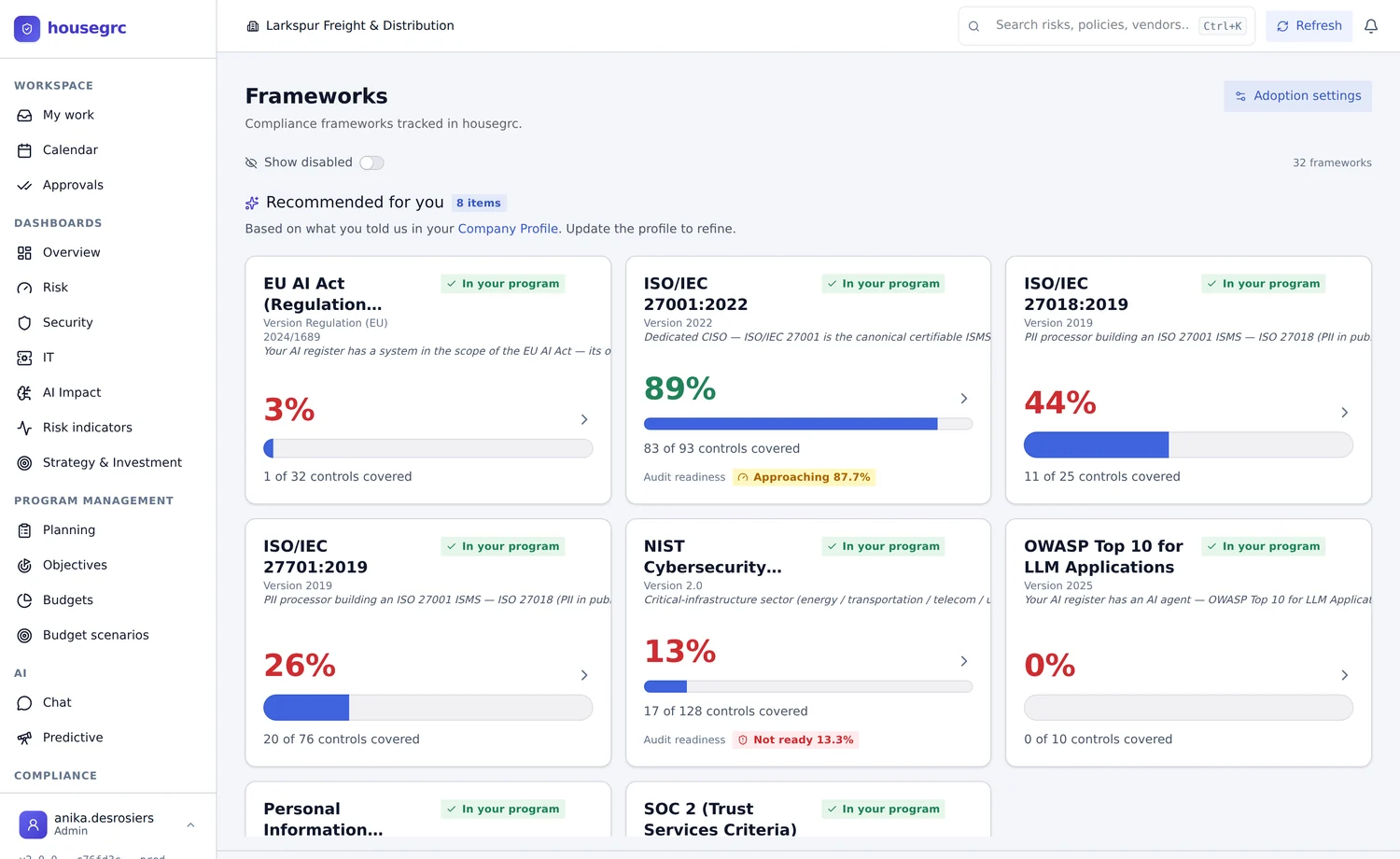
You adopt the security standards, privacy laws and sector regulations that apply to you. Their requirements map onto one shared controls library, so a control you implement once counts for every framework that needs it.
- A framework-to-project-plan generator, with implementation guidance for each control
- Audit readiness per framework, weighted by criticality, with its blockers and trend
- Continuous control checks that test collected evidence and raise or close findings
- A regulations register that tracks changes to the rules you follow
Evidence and audits
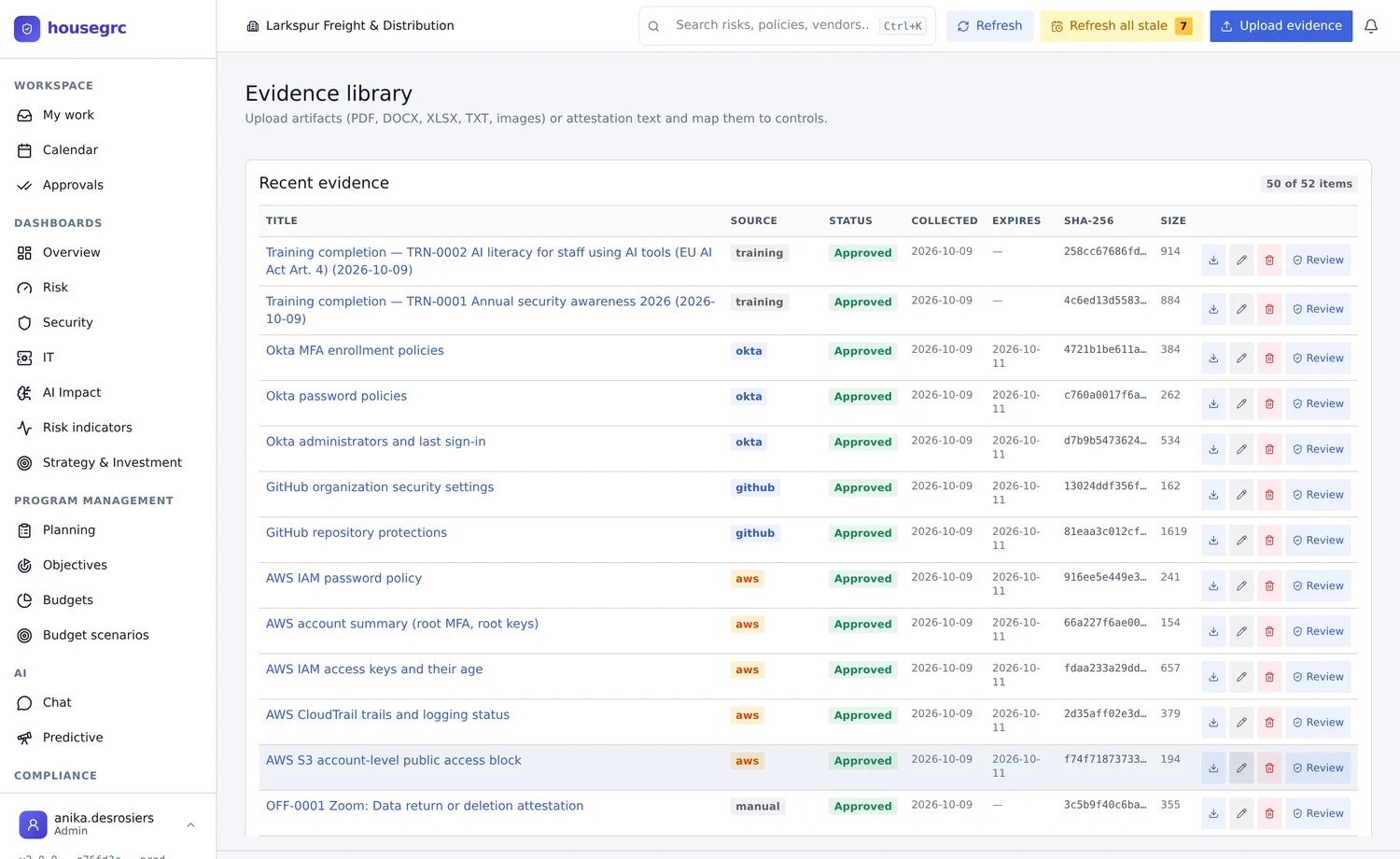
You can upload evidence or collect it on a schedule from cloud, source-control and identity providers, and HouseGRC maps it automatically to each control it satisfies. When the audit comes, you sample controls, write findings in workpapers and export a bundle for the external auditor.
- Evidence freshness: what's about to go stale, and who has to renew it
- Audit windows, certifications and governance ceremonies on one calendar
- Findings, exceptions and risks on one severity scale
Risk and governance
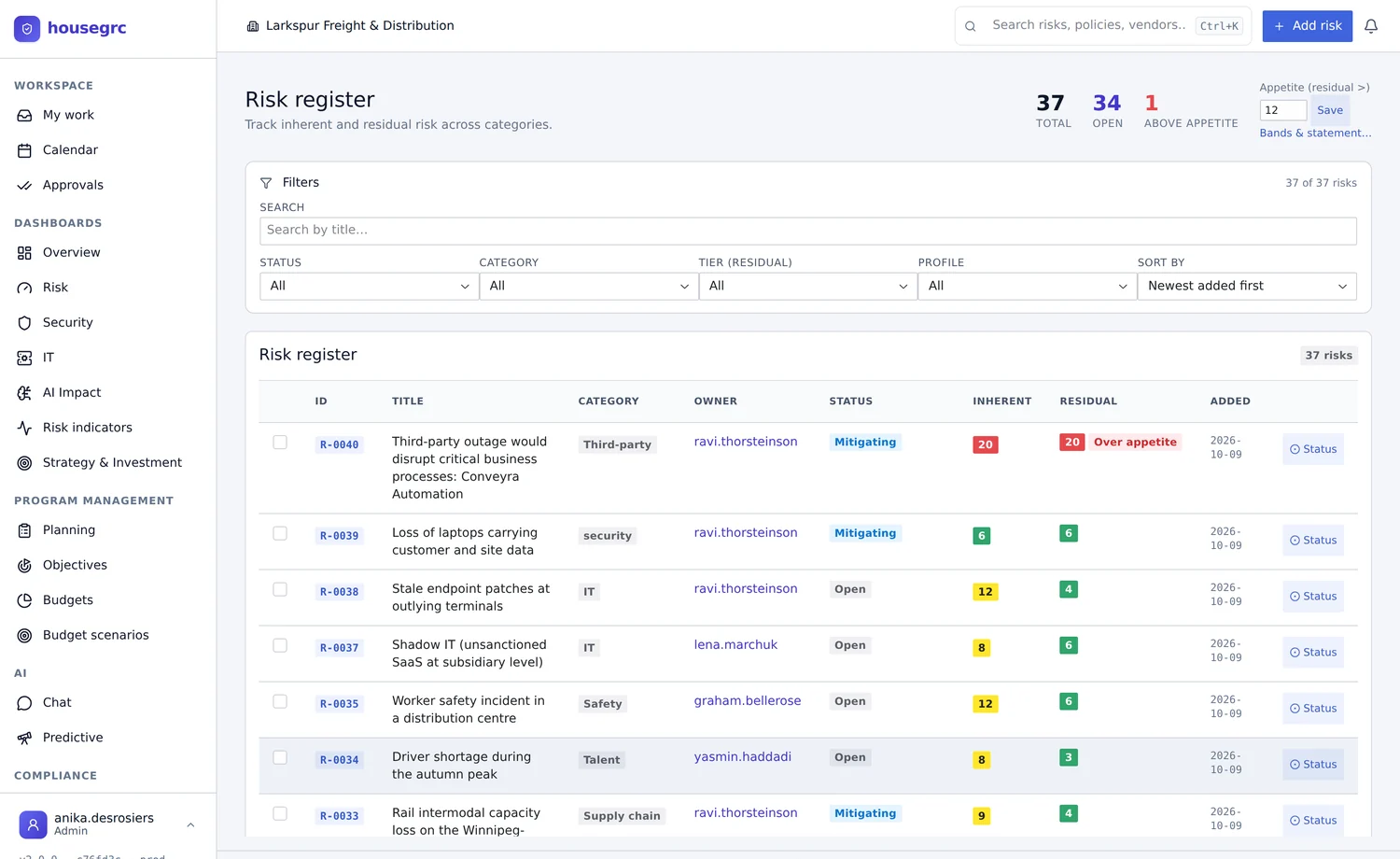
Risks are scored before and after controls. You set an appetite for each category, and accepting anything above it takes two approvers. Key risk indicators keep their history and alert on breaches, and business objectives show how well their risks are covered.
- Heat maps, treatment plans and risk owners with dated actions
- A key risk indicator library to start from
- Policies with templates, versions and a review and approval workflow
- Separation of duties on every approval, and toxic permission combinations reported
Third parties
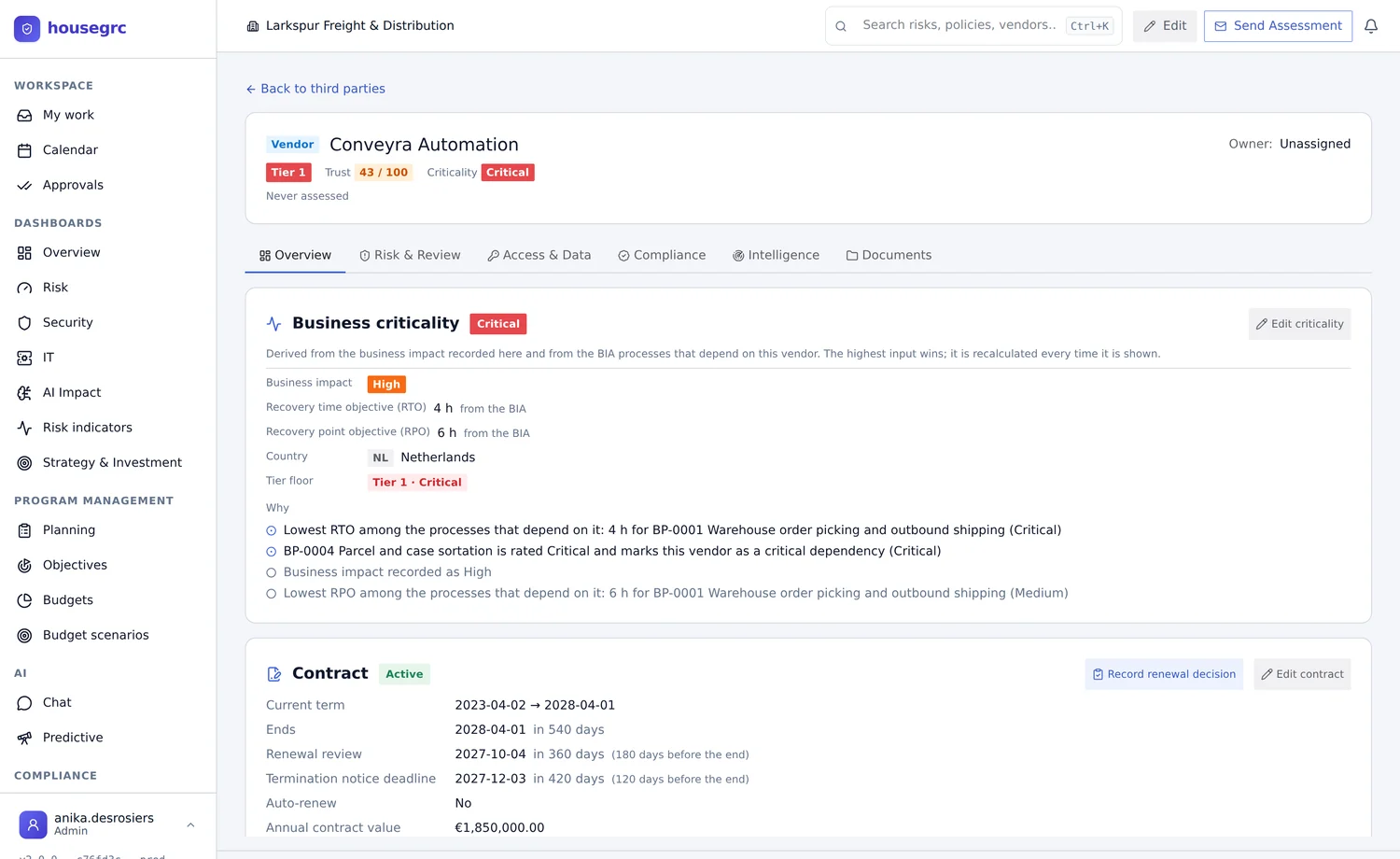
Vendors are tiered automatically, and you can see why each one landed where it did. Assessment questionnaires go out by link or email, and vendors answer without an account. A vendor's criticality comes from the business processes and recovery objectives that depend on it.
- Trust and exposure scores fed by profiles and assessments
- Concentration and single points of failure
- Contract renewals, terms-of-service reviews and offboarding checklists
Assets, vulnerabilities and exposure
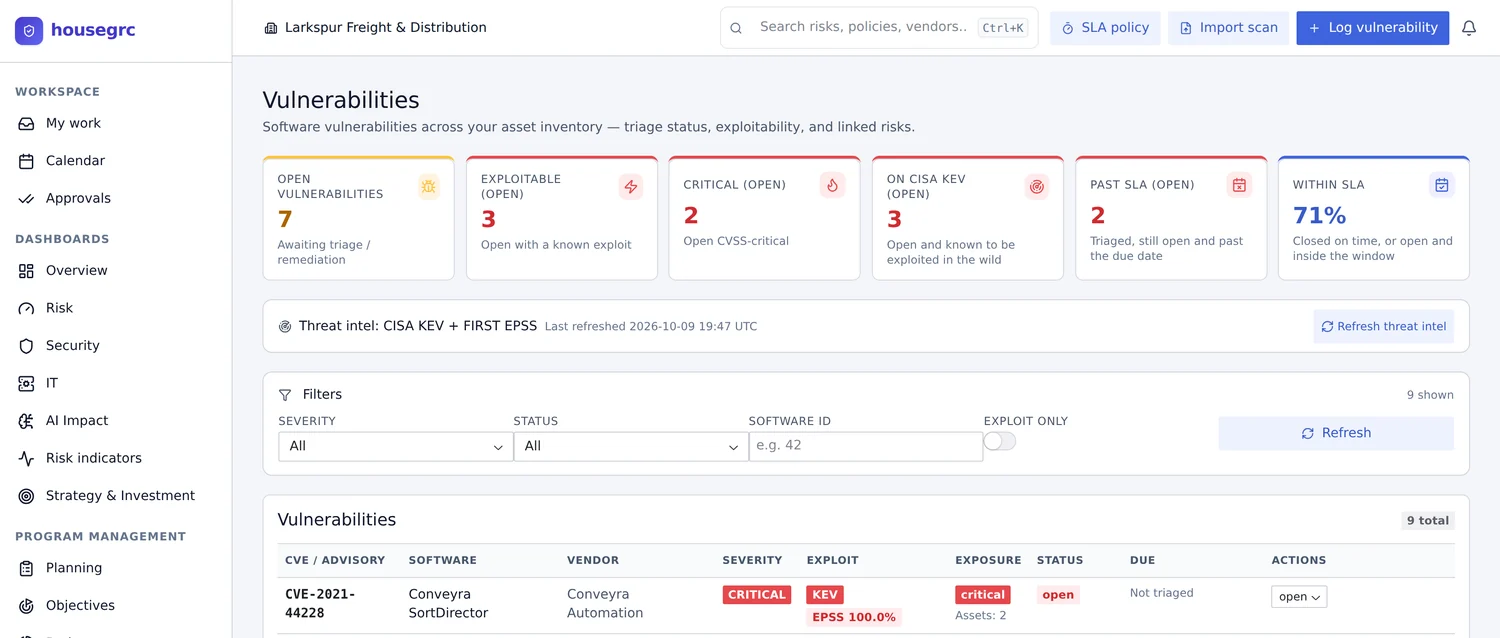
The inventory of software and systems is linked to the vendors behind them. The vulnerability register takes in public vulnerability data and scanner exports, and remediation deadlines are ranked by known exploitation and by how likely an exploit is.
- Imports of common vulnerability-scanner export formats
- External attack-surface discovery from certificate transparency for your verified domains
- Certificate expiry watch, data classification and threat models traced to controls
Incidents and resilience
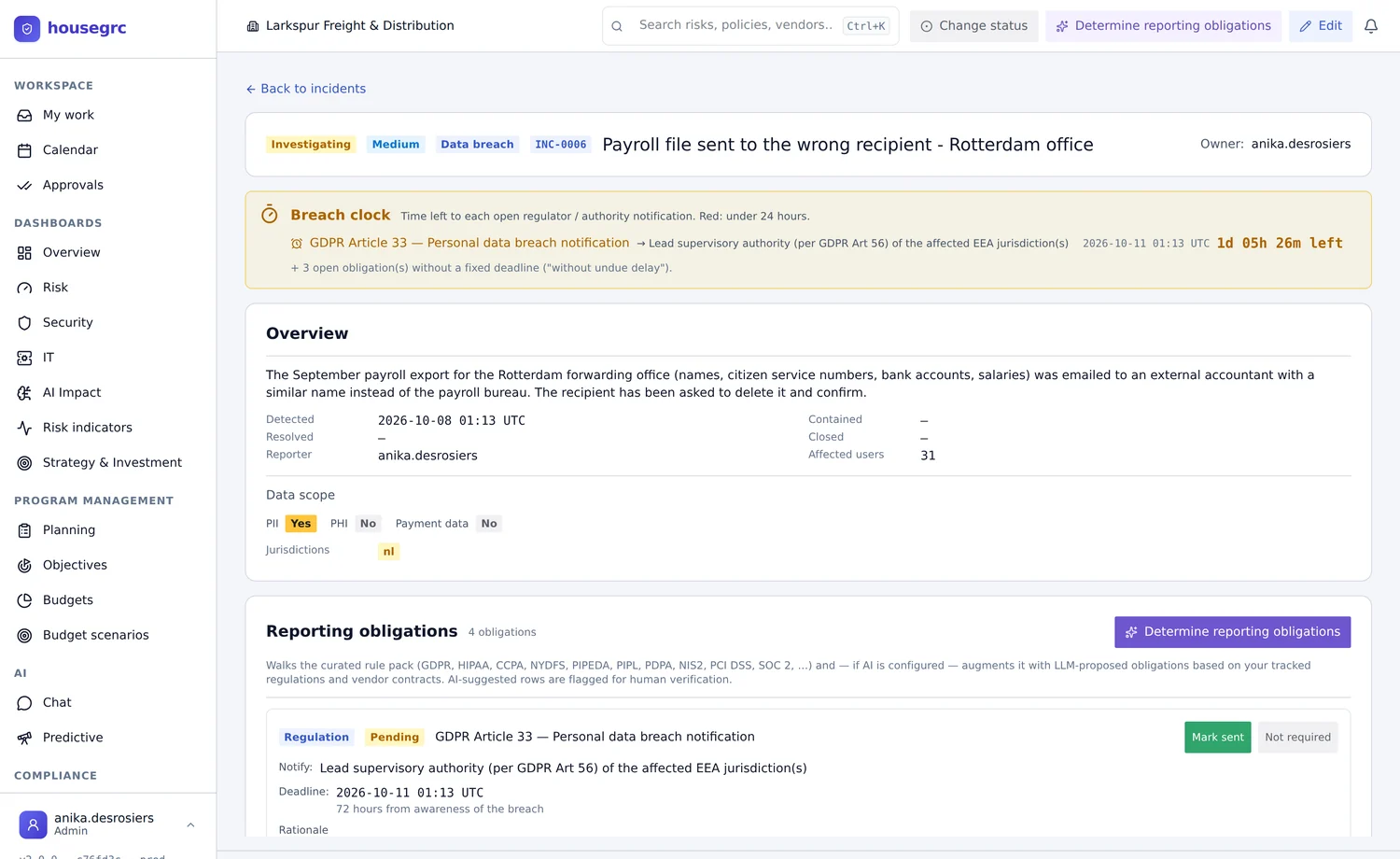
Incidents are logged and assigned through an on-call rota, and each one shows which notification obligations it triggers, where, and how long you have. Business impact analysis and the continuity, recovery and response plans have phased steps tagged by role, and reviews that recur.
- A live countdown to each regulatory notification deadline, with escalation
- Corrective actions and structured post-incident reviews
- Incidents linked to the risks they realised
Privacy and AI governance
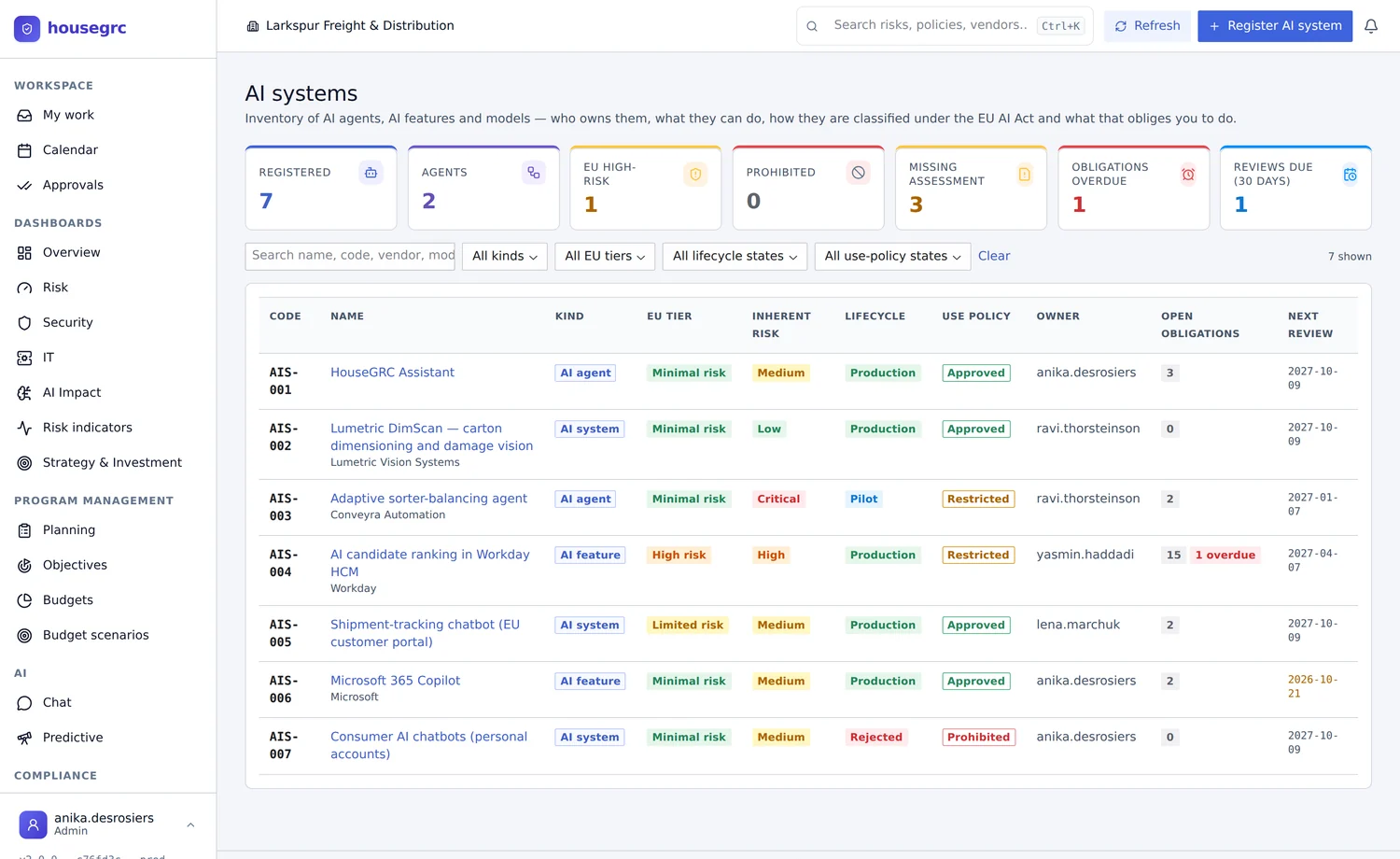
There's a record of processing activities with lawful bases and transfer safeguards, impact-assessment screening and sign-off, and data-subject requests. The register of AI systems and agents classifies each one under the EU AI Act and lists the obligations it triggers.
- Where restricted data flows, from the systems that hold it
- AI impact assessments, scheduled evaluations and kill-switch tests
- Detection of AI in use that nobody registered
The rest of the programme
- Identity and access
- Access reviews where "revoke" removes the access, time-limited group membership, just-in-time requests and recorded break-glass sessions.
- People
- Security-awareness and AI-literacy training with completion evidence, phishing-simulation records with refreshers, and a human-risk score that respects people's privacy.
- Reporting
- Executive dashboards, a composite posture score, alerts you configure, and a board pack in your branding that can be emailed every month.
- My Work and the calendar
- Each module produces actions with an owner and a date. Each person sees theirs in one queue, and the whole programme shares one calendar.
- AI assistant
- Optional. A read-only assistant answers questions from your own records and drafts suggestions that a person accepts. It uses the AI provider and model you choose.
- Integration
- A REST API with scoped keys, single sign-on with SAML and role mapping, SCIM provisioning, and imports and exports in common formats.
- Several organisations
- Subsidiaries, business units or clients in one installation, kept strictly apart, with parent organisations able to see their children.
- 14 languages
- The interface in English, French, German, Spanish, Portuguese, Italian, Dutch, Danish, Swedish, Norwegian, Finnish, Polish, Greek and Japanese, with local dates and numbers.
- Backups and restores
- Scheduled backups of the encrypted database and the evidence, and a trash bin that restores anything deleted by mistake.
Getting HouseGRC
It's free for any use, personal or commercial. A free licence key gives you every feature, on your own server.